
DANCE THROUGH THE GALLERY
Tuesday, April 14, 2026, 7:30pm
Meyerson Symphony Center + Livestream
Jerry Junkin, Artistic Director & Conductor
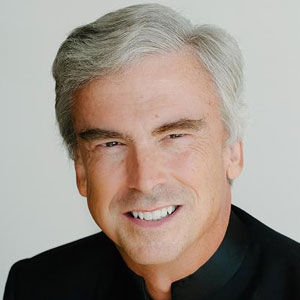
In his 31st season as Artistic Director and Conductor of the Dallas Winds, Jerry Junkin is recognized as one of the world’s most highly regarded wind conductors. He has served as Music Director and Conductor of the Hong Kong Wind Philharmonia since 2003, and Principal Guest Conductor of the Senzoku Gakuen College of Music Wind Symphony in Tokyo since 2007. Additionally, 2024-2025 marks his 36th year on the faculty of The University of Texas at Austin, where he holds the Vincent R. and Jane D. DiNino Chair for the Director of Bands. There, he also holds the title of University Distinguished Teaching Professor. Previously, he served on the faculties of both the University of Michigan and the University of South Florida. In addition to his responsibilities as Professor of Music and Conductor of the Texas Wind Ensemble, he serves as Head of the Division of Conducting and Ensembles and teaches courses in conducting and wind band literature. He is a recipient of multiple teaching awards, and students of Mr. Junkin hold major positions throughout the world.
Mr. Junkin is an enthusiastic advocate of public school music education, having conducted All-State bands and festivals in forty-eight states and on five continents. He spends his summers in residence at the Interlochen Arts Camp in Michigan, as well as appearing at major music festivals throughout the world.
Mr. Junkin has served as President of the Big XII Band Director’s Association and is a member of the Board of Directors of The John Philip Sousa Foundation, is Past-President of the American Bandmasters Association, and is Past President of the College Band Directors National Association. Regularly making guest appearances with ensembles such as the Tokyo Kosei Wind Orchestra and the Taipei Symphonic Winds, he continues to conduct throughout the United States in addition to multiple appearances in Japan, China, and Europe. In 2005, he was presented the Grainger Medallion by the International Percy Grainger Society in recognition of his championing of Grainger’s works, and he has received numerous career awards from Kappa Kappa Psi, Phi Beta Mu, and the Midwest Clinic, among others. Mr. Junkin is a Yamaha Master Educator.
Seraph Brass, guest artists
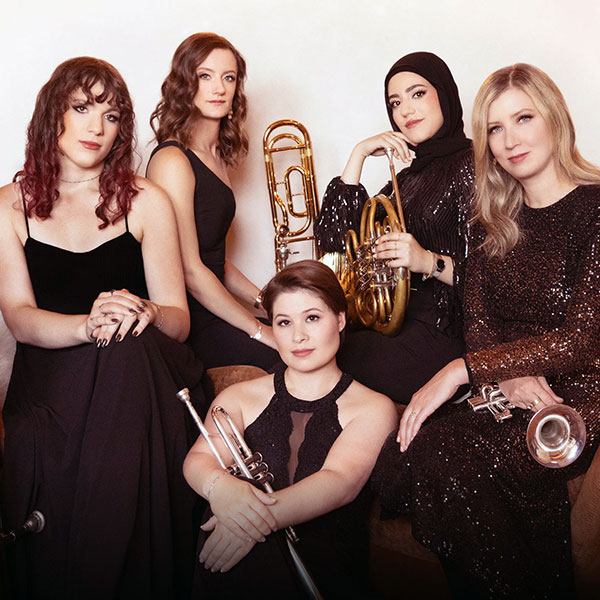
Seraph Brass, now in its 12th season, was founded by trumpet soloist Mary Elizabeth Bowden with a mission to showcase the excellence of women brass players and to highlight musicians from marginalized groups, both in personnel and in programming. Winners of the American Prize in Chamber Music, the group has been praised for its “beautiful sounds” (American Record Guide), “fine playing” (Gramophone), and “staggeringly high caliber of performance” (Textura).
2025-2026 season highlights include a premiere of a new concerto by Steven Juliani for Brass Quintet and Wind Ensemble with Jerry Junkin and the Dallas Winds, a tour of Japan’s major cities, Anthony DiLorenzo’s Chimera with the University of Texas in Austin, as well as residencies at Chamber Music Tulsa, Indiana University of Pennsylvania, San Jose State University, Kansas State University, University of California in Davis, University of Wisconsin in Platteville, Penn State Behrend in Erie, and Concordia University Wisconsin in Mequon.
Seraph Brass performs a diverse body of repertoire, ranging from original transcriptions to newly commissioned works and core classics. The group has commissioned pieces by Grammy award winner Jeff Scott, as well as Jennifer Jolley, Joseph Hallman, Catherine McMichael, Marcus Grant, and Rene Orth. The pieces by Orth and McMichael are featured on Seraph’s Silver Medal Global Music Award-winning debut album Asteria. The group regularly participates in commissioning consortiums, recently supporting works by Gala Flagello, Kevin Day, Mischa Zupko, Sara Jacovino, and Lillian Yee. Seraph recently commissioned and premiered Jennifer Jolley’s Dust for brass quintet and wind ensemble, which was performed with various ensembles across the US. Other concerto performances have included Rick DeJonge’s Prelude and Fantasy, James Stephenson’s Dodecafecta, Suite from Mass by Leonard Bernstein and Anthony DiLorenzo’s Chimera.
The ensemble has toured around the world in South America, Asia, Europe, and in 40 United States, including performances at the Tafalla Brass Week in Spain, Lieksa Brass Week in Finland, the International Festival of Winds of Cusco in Peru, the Busan Maru International Music Festival and the Jeju International Wind Ensemble Festival in South Korea, University of Toronto in Canada, the Forum Cultural Guanajuato in Mexico, International Women’s Brass Conference, the International Trumpet Guild Conference, the International Midwest Clinic Band and Orchestra Conference, and a two-week tour across China.
Seraph Brass is a Yamaha Performing Group. Website >>>
Fanfare
7:15pm, Meyerson lobby
Exuberances!
John Dupuis
Greater Dallas Youth Orchestra Wind Symphony Brass & Percussion
Jeremy Kondrat, conductor
Program
Selections from “The Danserye”
Tielman Susato, arr. Patrick Dunnigan
- La Morisque
- Bergerette
- Les quatre Branles
- Fagot
- Den hoboecken dans
- Ronde & Salterelle
- Ronde & Aliud
- Basse danse: Mon desir
- Pavane: La Battaille
The Distant Band *World Premiere*
Steven Juliani
Seraph Brass, guest artists
Mary Elizabeth Bowden, trumpet; Morgen Low, trumpet;
Layan Atieh, horn; Lauren Clyde-Casey, trombone;
Cristina Cutts Dougherty, tuba
— INTERMISSION —
Pictures at an Exhibition
Modest Mussorgsky, orch. Maurice Ravel, tr. Paul Lavender
Promenade
1. The Gnome
Promenade
2. The Old Castle
Promenade
3. Tuileries (Children Quarreling After Play)
4. Bydlo (Cattle)
Promenade
5. Ballet of the Unhatched Chicks
6. Samuel Goldenberg and Schmuÿle
7. The Marketplace (Important News)
8. Catacombs (A Roman Sepulchre)
With the Dead in a Dead Language
9. The Hut on Hen’s Legs (Baba Yaga)
10. The Great Gate of Kiev
Dallas Winds Personnel
PICCOLO
Margaret Shin Fischer
FLUTE
Abby Easterling, principal
Kathy Johnson
OBOE
Abigail Hawthorne, principal
Nathan Ingrim
ENGLISH HORN
Aryn Mitchell
E♭ CLARINET
Sam Day
B♭ CLARINET
Deborah Fabian, concertmaster
Sharon Deuby, associate principal
Mary Druhan
Ricky Reeves
Jake Hale
Kristen Thompson
Andre Canabou
Ben Quarles
Mark Arritola
BASS CLARINET
Mickey Owens
CONTRA CLARINET
Robin Owens
BASSOON
Laura Bennett Cameron, principal
Marty Spake
CONTRABASSOON
Leslie Massenburg
SOPRANO SAXOPHONE
David Lovrien
ALTO SAXOPHONE
David Lovrien, principal
Chris Beaty
TENOR SAXOPHONE
Roy E. Allen
BARITONE SAXOPHONE
John Sweeden
TRUMPET
Tim Andersen, co-principal
Raquel Samayoa, co-principal
Forrest Albano
Richard Adams
Daniel Kelly
Shaun Abraham
Jared Broussard
HORN
Joseph Charlton, principal
Eric Hessel
Derek J. Wright
Timothy Stevens
Sarrah McCoy-Black
TROMBONE
Amanda Hudson, principal
Jacob Muquiz
Josh Stout
BASS TROMBONE
Barney McCollum
EUPHONIUM
Donald Bruce, principal
Danny Chapa
TUBA
Jason Wallace, principal
Nick Beltchev
STRING BASS
Andrew Goins
HARP
Alison Read
PIANO, CELESTA
Cameron Hofmann
TIMPANI
Jacob Hord, principal
PERCUSSION
Roland Muzquiz, principal
Michael McNicholas
Nate Collins
Steve McDonald
Joe Ferraro
Brandon Kelly
Jon Lee
Staff
Michelle E. Hall – Executive Director
Jerry Junkin – Artistic Director & Conductor
Ramon Muzquiz – Concert Operations & Stage Manager
Grace Lovrien – Executive Assistant
Todd Toney – Director of Education
Michelle Shaheen – Development Coordinator
Lenore Ladwig Scott – Bookkeeper
Tim Andersen – Personnel Manager
Chrystal Stevens – Music Librarian
Jeremy Kondrat – Associate Conductor
Stage Crew
Livestream Crew
Adam Ellard – Director
Savannah Ekrut – Switch, Camera
Lydia Amstutz – Titles
Todd Toney – Score Reader
Christopher Cook – Remote Cameras
Don Hazen – Video Systems Engineer, Camera
Scott Probst – Recording Engineer
David Lovrien – Title Design
Meyerson Technical Staff
Gerry Guerrero – Lighting Design/Technician
Michael Marbry – Audio Technician
Evan Choate – Audio Technician
Lamar Livingston – Technical Director
Program Notes
Selections from “The Danserye” (1551)
Tielman Susato (Publisher) (1510/1515 – c. 1570); arranged by Patrick Dunnigan
It wouldn’t be until the earliest years of the Baroque Era (1597) that composers would begin to specify which instruments they intended for use in a performance of their work. Prior to this, performers simply chose whichever instrument best suited the music. Tielman Susato, who was born nearly a century earlier, was one of the most important music publishers of the sixteenth century. He was the first music publisher in all of the Low Countries (The Netherlands and Belgium). Being a publisher was often regarded as being of a higher status than being a mere composer. While it’s clear that Susato was a composer of some note, it’s unknown if Susato wrote all the works that appear in his publications.
His publication, “The Danserye” (originally, titled simply the “Third Book of Music”), from 1551 was clearly indicated for instrumental use. Many of the instruments used would be the predecessors of today’s band instruments. Music for wind instruments was highly important in the Renaissance era, and many strange and wonderful wind instruments were in use. One of Susato’s favorite instruments was the crumhorn. In fact, the name of his publishing house was “At the Sign of the Crumhorn.” In many ways, this music is some of the earliest band music that exists, as it was often performed in groups of all wind instruments.
Patrick Dunnigan has reimagined nine of the original fifty-seven pieces from “The Danserye” for modern wind band. The most famous of these pieces is the finale: The Battle Pavane.
The Distant Band (2026) *World Premiere*
Steven Juliani (b. 1960)
(Notes by the composer) This is the first piece I’ve written where I had the title before I wrote a note. “The Distant Band” came to me when I first started thinking about the sound of a piece for solo brass quintet and wind ensemble. Something about that sound world reminded me of playing horn in the Golden Gate Park band when I was in high school. I imagined walking into the park, which is very large, hearing the sound of the band from far away and being drawn to it. I decided the piece would be about the journey to that distant band.
But as I worked, I realized that this preordained story was inhibiting my creativity. So, I decided to let it go and just follow my musical instincts without concern for whether or not those choices conformed to a narrative.
After finishing the piece, I tried to understand what I had created. I realized that it was still about being drawn to distant music except that now the journey was punctuated by my formative musical experiences. Memories from music I heard or concerts I played: The Beatles, the first time I heard the end of Mahler 1, playing the Pines of Rome and the Rite of Spring and many others. Recently it has been studying the masterpiece of the wind ensemble repertoire: Lincolnshire Posy by Percy Grainger. Those experiences triggered a large palette of emotions for me.
I see now that “The Distant Band” is a kaleidoscope of reminiscences – a more abstract journey. These are not quotes, instead they are sounds that emanate from my early, natural, connection to music, something at the core of my being.
The piece is in two parts and is based on three themes. The first part ends just after a solo played by the horn in the solo quintet which is followed by three quiet timpani notes. A short break in the music there seemed appropriate. The first of the themes is heard in the opening, played by harp, piano and timpani. It later comes back in a more compressed form played by the entire ensemble. The second theme is a chorale also heard in the opening, played first by the solo quintet. This theme is repeated a number of times. In the first part of the piece it is played by the whole ensemble in a way that is less recognizable. The last theme does not appear until the second half of the piece and that one is the foundation for the finale.
One of the challenges of writing this piece was that the timbre of the solo instruments is the same as the large brass section of the wind ensemble. Five solo brass could easily be overwhelmed by that larger force. For this reason, the brass section hardly plays for the first half of the piece. When they finally arrive, you will notice a real change in sound.
Maybe this music will remind you of a journey you have taken to be closer to something very dear to you, like me and my musical memories. I hope so, and I hope you enjoy the piece.
I am so honored that Seraph Brass, Maestro Junkin and the Dallas Winds asked me to write this piece. Thank you to them and to the members of the commissioning consortium who will be performing the work over the next year (in alphabetical order): Saratoga High School, Michael Boitz, Performing Arts, Department Chair; University of Nevada at Las Vegas, Thomas Leslie, Director of Wind Band Studies; University of Wyoming, Dr. Matthew Schlomer, Director of Bands; Western Illinois University, Dr. Mike Fansler, Director of Bands; and to my lifelong friend: Michael Gast, Principal Horn, Minnesota Orchestra (retired).
Pictures at an Exhibition (1874)
Modest Mussorgsky (1839-1881)
Orchestrated by Maurice Ravel (1875-1937); transcribed by Paul Lavender
Modest Mussorgsky’s Pictures at an Exhibition is one of the most well-known works in classical music. However, it is most commonly heard in an orchestration by the brilliant French composer Maurice Ravel. Originally, the work was a ten-movement piano suite written in June of 1874. It depicts a patron walking through a gallery of the works of the recently deceased artist and architect Viktor Hartmann, a friend of Mussorgsky. Mussorgsky intended the piece as an everlasting homage to his colleague. Today, only six of the original works of art have survived, while Mussorgsky’s tribute has lived on.
The work was originally published five years after the composer’s death by his good friend Nikolai Rimsky-Korsakov, who took it upon himself to edit the work and make “corrections.” Mussorgsky was notoriously a drunkard and left many of his works in a state of disarray. However, Pictures at an Exhibition was not one of them. The original manuscript is beautifully hand-written and shows no signs of Mussorgsky’s supposed “failings.” It is Rimsky-Korsakov’s edition that Ravel used for his orchestration.
Interestingly, Mussorgsky uses a variety of languages for his titles. Latin, Italian, French, Polish, Yiddish, and Russian are all used to give the work a pan-European and pan-cultural feel. The key structure of the piece is also of importance. If we look at how each movement’s tonal centers relate to one another, we can see a well-thought-out internal structure for the entire work. This structure is one reason the final movement’s climax is so satisfying.
Promenade – We open the work with the first of several promenades. These movements represent the patron of the gallery walking between the paintings. This opening statement is heroic and bold and characterized in Ravel’s orchestration by the solo Trumpet.
1. Gnomus [Gnomes] – Latin – We can only guess what Hartmann’s gnome was, as the original painting has not survived. If the music is a guide, we can picture a maligned little creature full of spite and tricks. This is an angular movement with jarring transitions and creaking rumblings.
Promenade – In contrast to the opening promenade, this version is much more subdued and relaxed.
2. Il veccio castello [The Old Castle] – Italian – Set in the style of a Sicilienne (a slow dance in 6/8 time with dotted rhythms), The Old Castle has one of the most hauntingly beautiful melodies in the entire work. Ravel’s orchestration gives a chance for the Alto Saxophone to shine.
Promenade – This promenade is heavy and ponderous, with a special emphasis on the bass.
3. Tuileries (Dispute d’enfantes après jeux) [Quarrels of Children after Play] – French – In stark contrast to the ponderous promenade that precedes this movement, Tuileries is light and effervescent. Ravel’s orchestration leaves out most of the lower instruments in the ensemble. The painting, now sadly lost, depicts children at play in the French gardens of the Tuileries just outside of the Louvre in Paris.
4. Bydło [Cattle] – Polish – This is perhaps the most unusual movement in the work, and it poses more questions than it answers. What was the original painting that is now lost? Why did Mussorgsky choose Polish for the title? Why did Rimsky-Korsakov leave out the opening dynamic (fortissimo) in his published score?
Ravel’s orchestration is most famous for the tuba solo in this movement. Because it was written for the now largely forgotten French Tuba in C (a small instrument pitched a whole step higher than the modern Euphonium), it is most commonly played today on the Euphonium – even in the orchestra.
Promenade – This promenade, now shifted to a minor key, takes a darker turn from the previous iterations. It leads directly into the next movement.
5. Balet nevylupivshikhsya ptentsov [Ballet of the Unhatched Chicks] – Russian – This is the lightest and fastest of all the movements in the work. It depicts a sketch of Hartmann’s costumes for a ballet about a Scottish house spirit who falls in love with a housewife.
6. “Samuel” Goldenberg und “Schmuÿle” – Yiddish – This work, often given the subtitle “Two Jews: One Rich, One Poor,” is most likely based on a pair of small portraits by Hartmann. Mussorgsky himself owned these paintings. This movement is characterized by two themes. The first is imperious and heavy, while the second is almost mocking in nature. We hear the dialogue of the two as almost quarrelsome.
(At this point a recapitulation of the opening Promenade was omitted by Ravel.)
7. Limoges. Le marché (La grande nouvelle) – [The Market (The Great News)] – French – This movement depicts the market in the city of Limoges, France. Mussorgsky crossed out the subtitle of “The Great News” as well as two paragraphs in French detailing a quarrel between two women. The vigorous action of this movement leads directly into the solemn nature of the next.
8a. Catacombæ [Catacombs], and 8b. Cum mortuis in lingua mortua [With the Dead in a Dead Language] – Latin – These two movements are treated as a pair and are the darkest and most somber moments in the entire work. We can interpret this as Mussorgsky mourning for his lost friend, Hartmann. Catacombæ is built on giant block chords alternating between loud and soft, while Cum mortuis in lingua mortua is a dark form of the promenades we’ve heard throughout this work. In this movement, we hear the promenade melody for its final time, as if it is fading off into the afterlife itself.
9. Izbushka na kuryikh nozhkakh (Baba-Yaga) – [The Hut on Fowl’s Legs (Baba Yaga)] – Russian – Perhaps one of the most well-known sections of the entire work, The Hut on Fowl’s Legs reminds us of old fairy tales of boogeymen and witches luring children to their house in the woods. Hartmann’s actual painting is far more innocent, as it is simply an ornate clock that one might find on the mantle over a fireplace (albeit one with the legs of a chicken).
10. Bogatyrskiye vorota (V stolnom gorode vo Kiyeve) – [The Bogatyr Gates (In the Capital in Kyiv)] – Russian – Often called the Great Gate of Kyiv, the final movement of the work is one of the most triumphant endings in all music. It borrows heavily from Russian Orthodox chant. Mussorgsky’s original word “Bogatyr” is often translated as heroes. Bogatyrs were the heroes in many Russian and Ukrainian folk tales. Hartmann’s picture depicts a proposed grand gate into the city to honor those who have fallen in battle. This movement, designed to welcome heroes into their home city of Kyiv, becomes all the more poignant in its original title when we consider current global affairs.